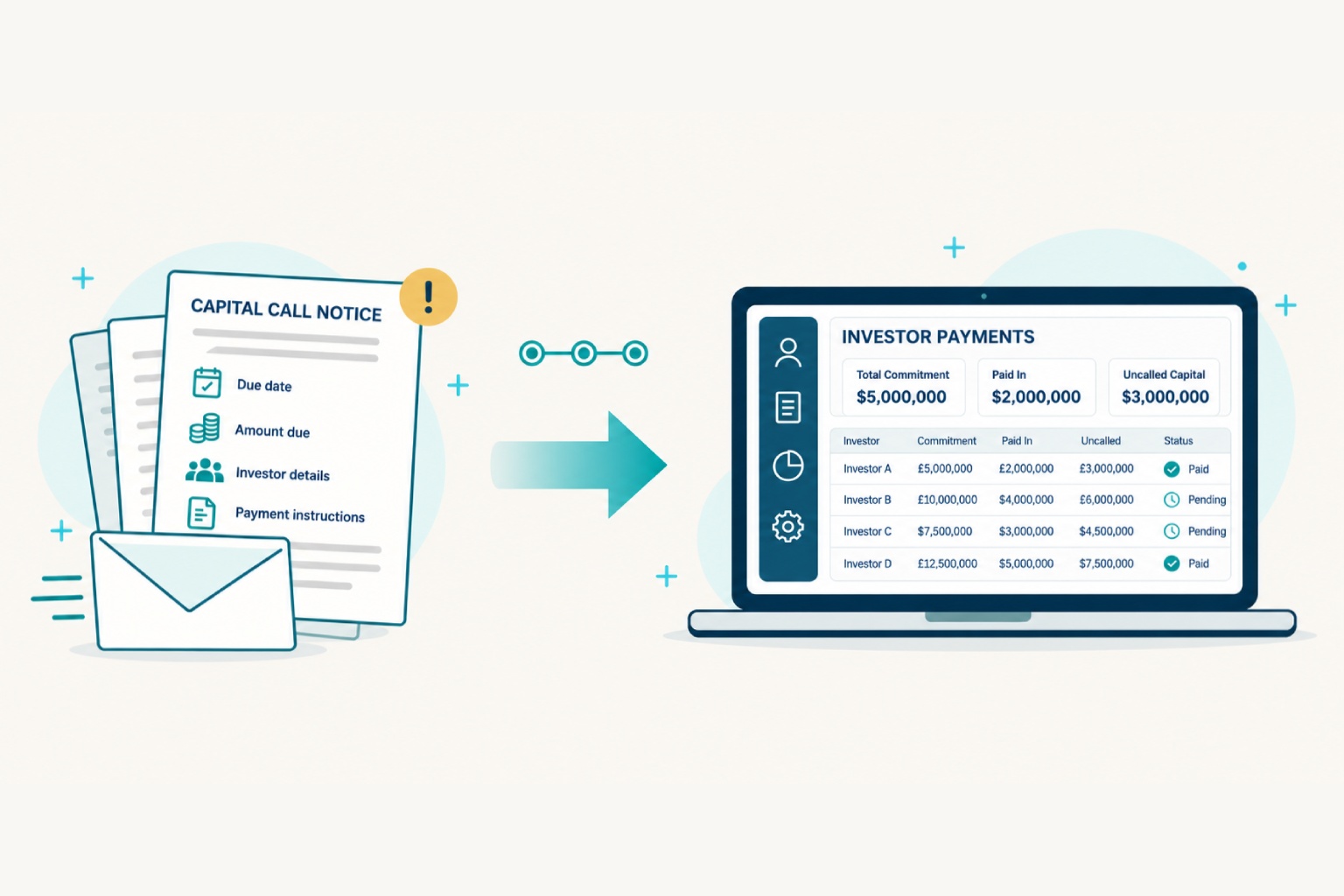
A capital call is a formal request from a private fund asking investors to provide part of the capital they have already committed. Instead of transferring their full commitment when they join the fund, limited partners (LPs) generally provide capital in stages as the general partner (GP) needs it for investments or other purposes permitted by the fund documents.
The idea is straightforward, but the administration around it can be less so. Effective capital call management involves keeping commitments, notices, payments, investor records, and follow-up work coordinated as capital moves into the fund.
Key takeaways:
When an LP invests in a private fund, they normally agree to a capital commitment: the total amount they can be required to contribute under the applicable fund documents. The commitment is generally not transferred to the fund all at once.
Instead, the GP draws down portions over time by issuing capital calls. This approach is commonly used by closed-end investment funds, including private equity, venture capital, and real estate funds. The governing documents, including the limited partnership agreement (LPA), establish the terms under which the capital may be called.
There are three terms that can help explain the relationship:
Suppose an LP commits £5 million and has so far contributed £2 million in response to previous calls. Its paid-in capital is £2 million, while £3 million of the original commitment remains uncalled.
A later call can request another portion of that £3 million, provided the request is consistent with the fund's governing documents.
The capital call doesn’t represent a new investment decision by the LP. It draws against a commitment that was made when the investor entered the fund.
Private funds typically invest over an extended period rather than deploying all their committed capital immediately. Capital calls allow the GP to bring money into the fund as needed, rather than collecting the entire commitment at the beginning.
A GP may issue a call to fund a new investment, make a follow-on investment, pay permitted fees or expenses, or meet another obligation covered by the fund documents. The LPA determines when and for what purposes capital can be called.
Calling capital closer to when it will be used can also limit the amount of uninvested cash the fund holds. This is an important consideration, because the timing of cash flows can affect fund performance measures such as internal rate of return (IRR).
For LPs, staged calls mean committed capital can remain under their control until it is requested. It also means they must plan for future funding obligations, even though the precise timing and size of each call may depend on the fund's investment activity.
The fund team faces an administrative trade-off. Rather than one initial transfer, the GP and its administrator may need to coordinate repeated calculations, notices, payments, reconciliations, and records across the investor base.
The capital call notice is the formal communication telling an LP that part of its commitment is now due.
There is no single universal notice format. The requirements depend on the fund and its governing documents. However, a notice will commonly provide information such as:
The fund administrator may issue the notice on the GP's behalf. Depending on the fund and the reason for the call, supporting information may also refer to the relevant LPA provisions or provide further details about the transaction or funding requirement.
Notice periods vary between funds and are set by the governing documents, but around 10 business days is common. The capital call notice will specify the actual payment deadline that applies to the LP.
For the fund team, issuing the notice is only the beginning. The request still has to be tracked through to receipt, reconciliation, and an updated investor record. Clear capital call communication and transparency are important for maintaining a consistent record of what investors have been told and when.
The exact process varies by fund, but the underlying sequence is broadly consistent across private equity, venture capital, real estate, and other closed-end funds.
When joining the fund, the LP commits an agreed amount of capital under the subscription and partnership documents. Some of that amount may remain uncalled for a considerable period.
The fund needs capital for an investment or another purpose permitted under the LPA. The GP determines how much to call and how to allocate the requirement across investors.
Each affected LP receives the amount due, deadline, payment instructions, and other information required by the fund's process and governing documents.
Investors transfer their respective contributions by the stated deadline. Once received, that money becomes part of the LP's paid-in capital.
The fund or administrator confirms what has been received, identifies outstanding amounts or other exceptions, and updates the relevant records.
Each contribution changes the LP's paid-in and uncalled capital position. Those movements also need to feed into the fund's accounting and investor reporting records, so contributions and remaining commitments stay accurate as successive calls are made.
The money movement itself may take only one step. But maintaining an accurate record of the call across every investor is the larger operational task.
A capital call, a capital contribution, and a distribution all involve money moving between a fund and its investors, but they describe different events.
The distinction between a capital call and a contribution is a matter of timing. The call is the request, and the contribution is the payment.
An LP that does not fund a valid call by the required deadline may become a defaulting investor.
There is no universal penalty for missing a capital call. The remedies available to the GP depend on the fund's governing documents. These may provide for financial penalties or other consequences affecting the investor's interest or rights in the fund.
That makes the LPA important to both sides. The LP needs to understand its call obligations before committing, while the GP needs to follow the agreed procedure if a call is not met.
Operationally, the fund team also needs to distinguish an outstanding payment from a resolved payment and maintain a clear record of each investor's status. If an amount remains unpaid, the relevant people need to know what was requested, when it was due, and what action has already been taken.
A capital call is sometimes discussed alongside a capital call line of credit, also known as a subscription line, but they are not the same thing.
A capital call is a request for LPs to provide capital they have already committed.
A subscription line is financing provided to the fund by a financial institution, generally against the fund's uncalled investor commitments. It can bridge the timing between a funding requirement and the later receipt of capital from LPs.
For example, a fund may draw on a facility to complete an investment and subsequently issue a call to investors. The capital call then brings investor money into the fund, which may be used in accordance with the facility and fund arrangements.
Whether a fund can use such a facility, and on what terms, again depends on its governing documents and financing arrangements. The LPA should therefore be reviewed alongside the facility terms to establish what borrowing is permitted.
The key distinction is that a capital call draws committed investor capital, while a subscription line is borrowing.
Capital call journal entries vary depending on the fund's structure, accounting framework, and accounting policy, so no single entry applies in every case.
Record a capital call according to the fund's accounting requirements rather than copying a generic example.
More broadly, capital calls form part of the fund's accounting record alongside contributions, investments, distributions, fees, and expenses. A general ledger records the financial activity and associated debits and credits, while investor-level records track the effect of calls and contributions on individual LP capital positions.
This creates two related records. The accounting entry itself and the evidence supporting it.
The fund needs to connect the financial record with the underlying capital activity. This can include the applicable call, amount requested, contribution received, investor balance, and reconciliation supporting the entry.
One call to one investor is relatively easy to follow. Complexity grows when a fund coordinates repeated calls across multiple LPs, deadlines, records, and parties.
Information may need to move between the GP, fund administrator, advisors, and investors. The team needs to keep the call itself aligned with investor data, supporting documents, communication, payment status, and subsequent reporting.
The difficulty is not necessarily any one task. It is maintaining a current view of the process as those tasks move between people.
As calls progress, the fund team needs a clear view of which LPs have been notified, which contributions have been received and reconciled, what remains outstanding, and who owns the next action. When that information is spread across documents, spreadsheets, email threads, and separate records, follow-up becomes a separate administrative task.
Capcade helps fund managers, administrators, service providers, and other parties coordinate recurring fund operations through shared workflows, tasks, records, and clear ownership. Its fund operations and administration solution includes capital calls and distributions, along with other recurring fund activities.
The GP still determines what to call and when, subject to the fund documents. Better coordination keeps the work around that decision connected.
A capital call is a formal request from a fund asking an investor to transfer part of the capital they previously committed. The GP issues the call when capital is required for an investment or another purpose permitted under the fund documents. The amount paid in response becomes a capital contribution.
In private equity, a capital call allows the GP to draw part of the capital committed by LPs as the fund needs it. Instead of collecting the full commitment upfront, the fund can request portions during its investment period and, where permitted, for later fund obligations.
The phrase can cause confusion because a subscription and a capital call describe different stages. An investor makes its commitment through the fund's subscription process. A later capital call requests payment of part of that committed amount. A "subscription line", by contrast, is a credit facility used by a fund and is not the investor's subscription agreement.
The consequences depend on the LPA and other applicable fund documents. An LP that fails to meet a valid call may be treated as a defaulting investor, and the documents may provide the GP with financial or other remedies. No single default penalty applies to every fund.
Suppose an LP commits £2 million to a fund. The GP later calls 10% of the investor's original commitment, so the LP receives a request for £200,000. Once that amount is paid, its paid-in capital increases by £200,000 and the uncalled portion of the original commitment decreases by the same amount.
There is no universal schedule. The frequency depends on the fund's investment activity, expenses, strategy, and governing documents. Some managers establish a regular cadence, while others issue calls around specific funding requirements.
A capital call links an earlier commitment with the money the fund needs now. At the investor level, the sequence is relatively simple, with the fund making a request, the LP contributing the required amount, and the remaining commitment updated. At the fund level, that sequence repeats and is recorded across investors, notices, payments, reconciliations, and reporting.
As those moving parts increase, clear ownership and connected records become as important as the call itself. The objective then is a process in which the fund team can see what has been requested, what has been received, and what still requires action without having to reconstruct everything after the event.


.svg)


.svg)


.svg)