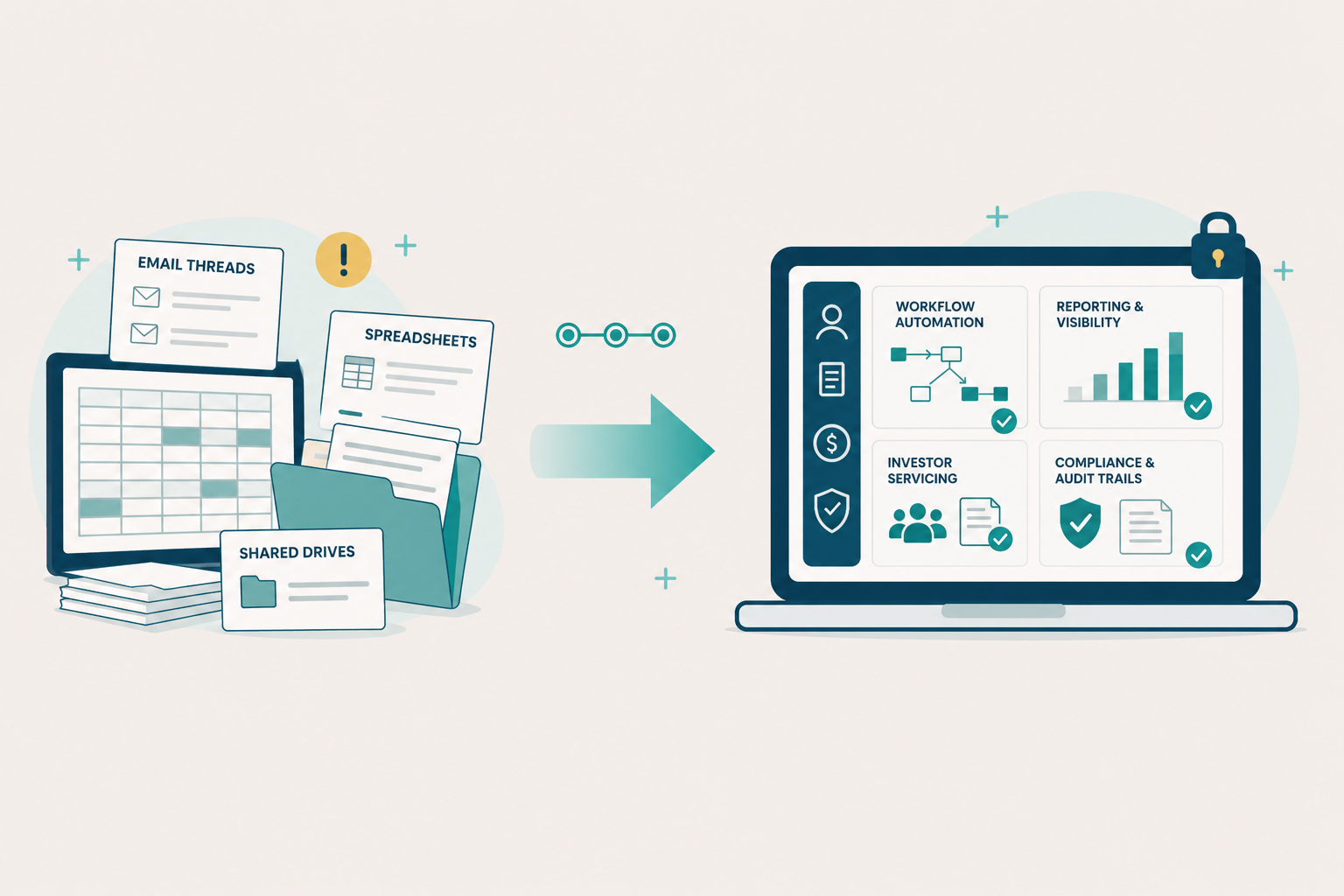
Fund operations and administration have grown significantly more complex. Increasing regulatory demands, growing investor bases, and the pressure to report faster and more accurately have exposed the limits of manual processes.
Purpose-built software solutions address these challenges directly, giving fund managers and administrators the tools to run leaner, more transparent, and better-controlled operations. In this article, we explore the most common operational pain points, how modern software resolves them, and what to look for when evaluating a platform for your fund.
Key takeaways:
Most fund operations teams default to familiar tools: spreadsheets, shared drives, and email threads. At a smaller scale, these work. As fund complexity grows, they become a liability. There is no version control, no clear task ownership, and no audit trail. Errors compound silently across multiple team members working from different document versions.
By the time a discrepancy surfaces, the damage to data integrity or an investor relationship may already be done. For funds operating in regulated markets, this is not an inconvenience. It is a material risk.
Read more: From Spreadsheets to Smart Workflows: How GPs Can Modernise Fundraising Operations
Fund administrators and operations teams face a consistent set of pressure points that grow harder to manage as funds scale:
Together, these challenges do not just create inefficiency. They introduce risk at every level of fund operations, from data integrity to regulatory standing to investor confidence.
Fund administration software replaces fragmented, manual workflows with a single, structured environment where data, documents, and tasks are connected. The operational gains are significant and span every dimension of fund administration.
Manual handoffs between team members, chased approvals, and repeated data entry are replaced by automated workflows with clear ownership and time-stamped task tracking. Teams spend less time coordinating and more time on work that requires judgment. Routine processes run consistently without depending on individual memory or inbox management.
When data is consolidated in one place, reporting automation becomes possible. From NAV calculations to investor reports, teams pull from a single source of truth rather than reconciling multiple spreadsheet versions. Reports are consistent, auditable, and produced on demand. Decision-makers get accurate information when they need it.
Investor onboarding, capital call notices, and distribution reports are all managed consistently across your entire investor base within a secure, controlled environment. Every interaction is logged, creating a clear record of what was communicated, to whom, and when. That transparency builds LP confidence in your operational discipline.
Compliance is embedded into the workflow rather than bolted on at the end. Every document access, task completion, and approval generates an immutable, time-stamped record. Role-based permissions ensure team members and external advisors access only what is relevant to their role. When regulators or auditors request documentation, the record is already there.
Read more: Fundraising Readiness Checklist for Your Next Private Markets Fund
The benefits that fund administration software delivers across efficiency, reporting, investor servicing, and compliance are not isolated improvements. They are the foundation that makes scaling possible. A fund that cannot report accurately at 50 investors will not manage at 200. A compliance process built on manual assembly will not hold up as complexity increases.
Fund operations platforms remove the ceiling that manual operations impose. Because the underlying workflows, data, and controls are already structured, growth adds volume without adding proportional complexity or risk. As your fund grows, your operations keep pace.
Read more: Effective Fundraising: Tools and Techniques for Capital Raising Success
Not all platforms are built equally. When evaluating back-office software for fund operations and administration, prioritize the following:
All fund information should be accessible in one secure, structured environment. Fragmented systems create reconciliation risk and slow down every downstream process that depends on accurate data.
Look for clear task ownership, time-stamped actions, and progress visibility across internal teams and external advisors. Repeatable workflows reduce the risk of steps being missed as fund complexity grows.
Secure document sharing, communication logging, and LP-facing reporting should be built into the platform rather than handled through separate tools. Consistency in what investors receive and when is both an operational and a compliance requirement.
Every document access, approval, and task completion should generate an immutable, time-stamped record. When regulators or auditors request documentation, the record should already be there.
The platform should connect with your current technology stack without requiring wholesale replacement. Funds should be able to centralize where work lives and where data is shared without abandoning tools that already work.
ISO 27001 certification and SOC 2 compliance are baseline indicators of institutional-grade security. These should be non-negotiable requirements, not differentiators, in any vendor evaluation.
Fund managers who move from manual processes to fund administration software report fewer errors, faster reporting cycles, and cleaner compliance records. The operational gains span every dimension of fund administration, from reporting automation and NAV calculations to investor onboarding and compliance audit trails. The tools exist to run leaner, more transparent, and better-controlled operations.
Explore Capcade's fund operations platform and see how back-office software can transform the way your fund runs.
Fund administration software is a purpose-built platform that centralizes document management, reporting, capital calls, investor communication, and compliance recordkeeping in a single, secure, and auditable environment.
General tools handle task coordination but lack the compliance, security, and audit requirements of financial services. A fund operations platform adds secure document management, investor servicing, regulatory recordkeeping, and fund-specific workflows.
Yes. Smaller teams have fewer resources to manage process gaps manually, making structured workflows proportionally more valuable. Building the right infrastructure early also means the fund does not need to restructure operations as it grows.
The signals are consistent: reporting cycles that stretch beyond LP expectations, compliance documentation assembled reactively, and coordination that depends on individual memory rather than a structured system.
By centralizing LP communications, documents, and reporting in one secure environment, fund administration software ensures investors receive consistent, timely, and accurate information, with every interaction logged and accessible.


.svg)


.svg)


.svg)