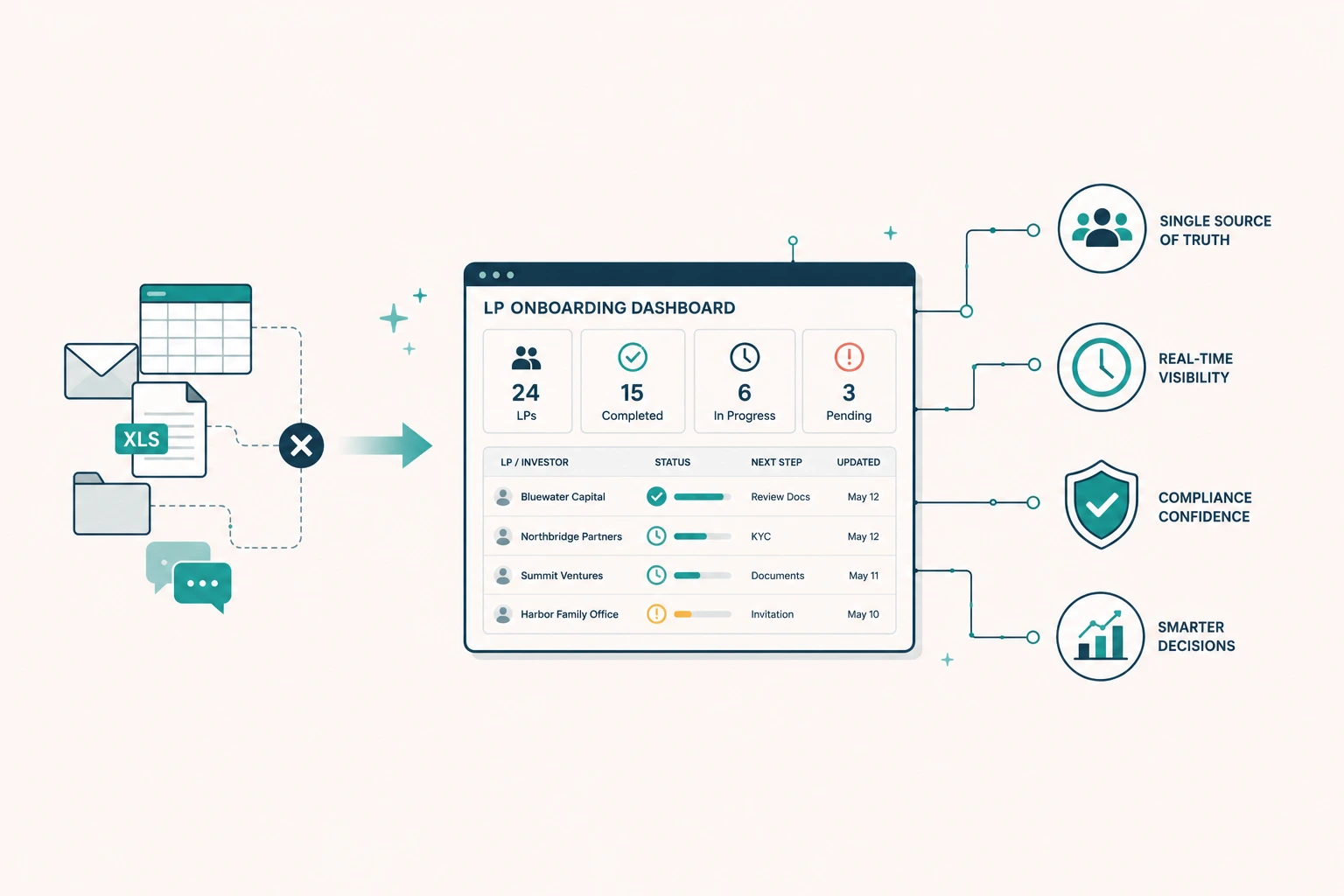
Fund managers often describe LP onboarding as one of the most operationally intensive parts of running a fund. Too much of the process still runs through disconnected tools: email chains, static spreadsheets, and shared drives that nobody fully trusts.
Real-time visibility changes this by giving every stakeholder a single, accurate view of each investor's position.
Key takeaways from this article:
An LP onboarding dashboard is a live interface that shows the status of every investor's onboarding steps in one place. Instead of manually chasing document submissions or updating a shared spreadsheet, fund managers and administrators see current progress across all limited partners without asking.
Read more: Streamlining Investor Onboarding: How to Build a Scalable KYC Process for Private Funds
Most funds start with spreadsheets because they are familiar, low-cost, and quick to set up. The problem emerges at scale: spreadsheets do not update automatically, they do not enforce permissions, and they create version-control problems the moment two people edit them simultaneously.
When a fund is onboarding 30 or 40 LPs at once, a spreadsheet becomes a liability. A missed row or an outdated status means compliance teams are working from inaccurate data, and that creates real risk.
Real-time visibility into LP onboarding reduces the number of manual check-ins required to keep a process on track. Fund administrators can see which investors have completed KYC, which documents are still outstanding, and where a bottleneck has formed.
This matters for three groups in particular:
When all three groups work from the same live data, coordination improves, and errors fall.
These compliance obligations reflect global standards such as the FATF 40 Recommendations, which financial institutions use as a baseline for client onboarding and ongoing monitoring.
Investor workflow tracking covers the movement of each LP through the onboarding sequence, from initial invitation through to account activation. The specific steps vary by fund structure and jurisdiction, but most onboarding workflows include some version of the following:
Tracking at this level of detail is only realistic when the system updates automatically. Manual logging introduces delays and creates gaps in the audit trail.
Onboarding analytics refers to the aggregate data generated by tracking individual LP journeys. Over time, this data shows where delays consistently occur, which document types cause the most friction, and how long onboarding takes on average across different investor types.
Fund administrators who use onboarding analytics can identify process improvements that would otherwise stay invisible. If KYC submissions from certain geographies routinely take longer, that is something a data-driven team can anticipate and plan around. Without structured analytics, every fund close feels equally unpredictable.
No, though there is overlap. Investor relations platforms typically focus on ongoing communication, reporting, and document distribution after onboarding is complete. Onboarding software, or fund administration software with onboarding functionality, focuses on the structured intake process.
The distinction matters because funds that use a general investor relations platform for onboarding often discover that it was not designed for compliance-driven workflows. The document routing, permission management, and audit trail requirements of onboarding are specific enough to need purpose-built tools.
Research on private‑fund governance points to the importance of structured, auditable workflows for LP onboarding and investor‑side documentation. The best LP onboarding platforms share a few practical characteristics:
Centralized collaboration is as important as tracking. When a query from an LP requires input from legal, compliance, and fund administration simultaneously, a platform that connects those teams in one workspace prevents the back-and-forth that delays decisions.
Read more: Fundraising Readiness Checklist for Your Next Private Markets Fund
What is LP onboarding visibility? LP onboarding visibility refers to the ability to see the real-time status of every investor's onboarding progress in one place, without relying on manual updates or email check-ins.
How does a live onboarding dashboard reduce compliance risk? A live dashboard creates a continuously updated audit trail. Compliance teams can confirm that each step was completed in the correct sequence, with timestamps, rather than reconstructing a process after the fact from email records.
Can small funds benefit from onboarding software? Yes. Even funds with fewer than 20 LPs benefit from structured tracking, because compliance obligations apply regardless of fund size. Manual processes create risk at any scale.
What is the difference between onboarding analytics and standard reporting? Standard reporting tells you what happened. Onboarding analytics tells you where delays occur, how long each stage takes, and where the process can improve. The distinction is between descriptive and diagnostic data.
How does centralized collaboration reduce onboarding delays? When documents, tasks, and communication sit in one workspace, everyone involved in a decision works from the same information. This removes the version confusion and missed replies that slow down email-based coordination.
Read more: The Importance of Secure Collaboration Software in Fintech Compliance
Real-time onboarding visibility sits within a broader category of secure, compliance-ready collaboration tools designed for regulated financial workflows. These platforms combine document management, task tracking, and cross-entity communication in a single workspace rather than spreading the process across multiple tools.
Platforms built for this environment, including Capcade's LP onboarding workspace, are structured around the audit and permission requirements that fund administration demands. They allow fund managers, compliance teams, and legal advisors to work within a shared, controlled environment where accountability is built into the workflow rather than enforced after the fact.
For fund managers evaluating options in this category, mapping your current process against the stages where visibility breaks down is a useful starting point. That analysis tends to surface the specific gaps a purpose-built platform is designed to address.
Real-time LP onboarding visibility addresses the same core problem this article opened with: fund managers running operationally intensive processes through tools that were never designed for them. The shift from reactive coordination to live, structured tracking is not a technical upgrade. It is a change in how clearly a team can see what is happening and act before small delays become material problems.


.svg)


.svg)


.svg)