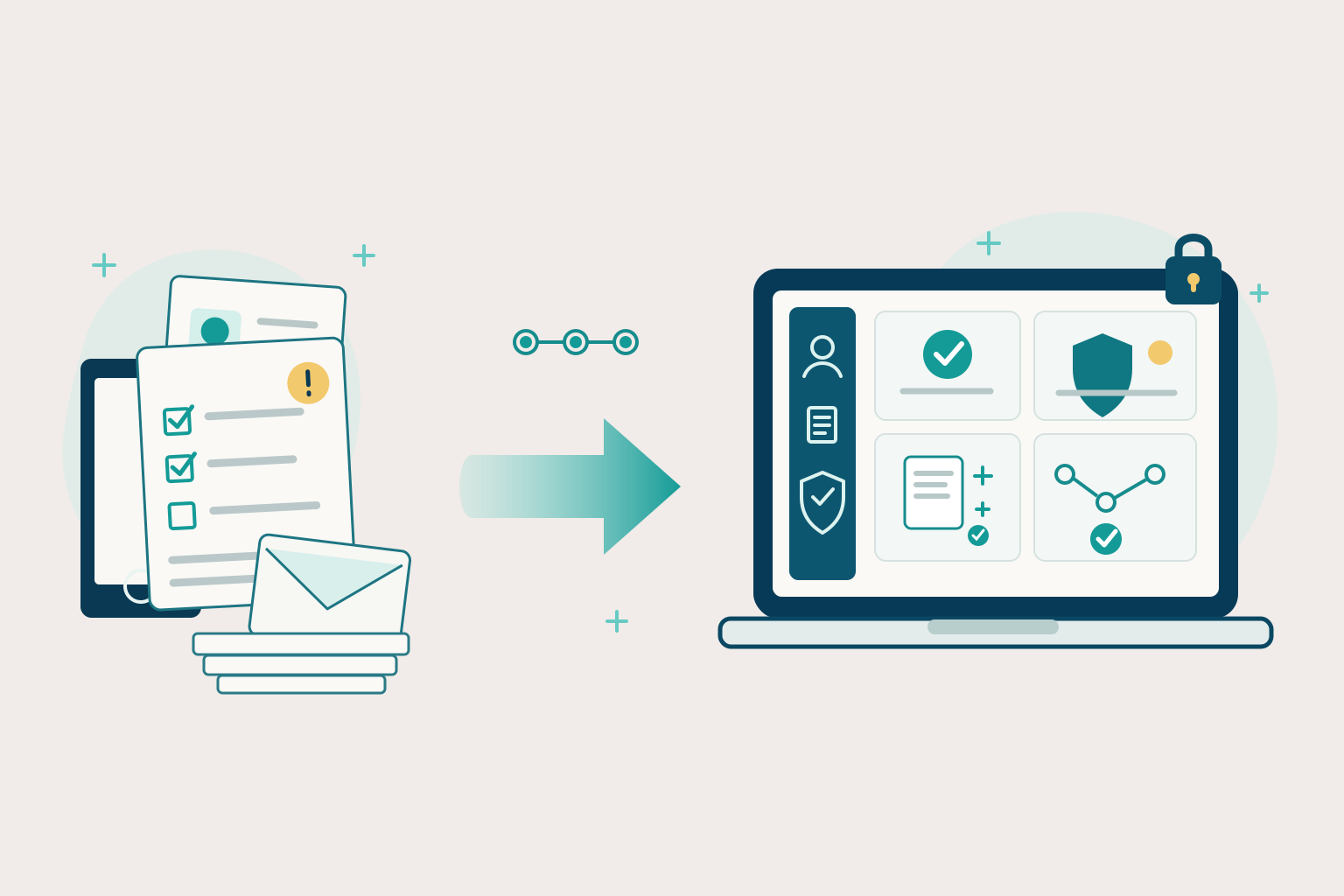
For private fund managers, KYC and AML compliance is not optional. It is a baseline regulatory requirement that grows more complex as your investor base expands. Yet many funds still rely on manual, email-based processes to manage KYC and AML compliance for private funds: documents collected ad hoc, approvals tracked informally, and audit trails that exist only in theory. This approach creates compliance risk, slows investor onboarding, and makes regulatory readiness difficult to demonstrate.
This article explores how to build a scalable investor KYC process for private funds, and how structured digital workflows and AI-assisted compliance tools can improve efficiency, visibility, and regulatory readiness.
Key takeaways:
Most fund managers know their KYC and AML obligations. Fewer have a process that reliably meets them. Across private funds, the investor KYC process is still largely manual: documents requested by email, stored across shared drives, and tracked through spreadsheets with no version control or clear audit trail.
This creates compliance gaps that are difficult to detect until a regulatory review or audit makes them impossible to ignore. The risk is not always visible in day-to-day operations. That is precisely what makes it dangerous.
A manual KYC process that works for ten investors will not work for fifty. As a fund grows, the volume of document requests, verification steps, and compliance checks multiplies. Without a structured workflow, onboarding slows down, investors experience delays, and compliance teams spend more time chasing paperwork than reviewing it.
Errors become more frequent and harder to catch. Regulatory obligations that were manageable at a smaller scale become difficult to demonstrate at a larger scale. Growth should be an operational asset. When your KYC workflow cannot scale with your fund, it becomes a liability instead.
Building a scalable investor KYC process starts with replacing ad hoc practices with a structured, repeatable compliance workflow that every investor moves through consistently. Here are the four core components every private fund should have in place:
Define exactly which documents are required from each investor type and build a consistent collection process around that list. Standardization ensures every investor is onboarded to the same compliance standard and forms the foundation of a smooth LP onboarding experience.
Read more: Why Real-Time Visibility Matters During LP Onboarding
Not all investors carry the same risk profile. A scalable AML compliance workflow assigns a risk tier to each investor based on factors such as jurisdiction, entity type, and source of funds. Higher-risk investors trigger enhanced due diligence requirements. This tiering approach ensures compliance effort is proportionate and defensible.
Every KYC decision should move through a defined approval process with clear ownership at each stage. Approvals should be time-stamped and logged automatically, creating an immutable audit trail that does not depend on email records or manual documentation.
KYC is not a one-time exercise. Investor circumstances change, and AML obligations require funds to monitor and review investor information on an ongoing basis. A scalable workflow builds periodic review triggers into the process so compliance monitoring runs continuously rather than reactively.
Building the right workflow is the foundation. The right technology is what makes it scalable. Here is how digital tools and AI-assisted compliance solutions transform each stage of the investor KYC process:
Digital onboarding replaces fragmented email-based document collection with a structured, trackable process. Investors move through a defined sequence of steps, documents are collected and verified within a single environment, and nothing progresses until each stage is complete. Automation removes the manual handoffs that slow onboarding down and introduce errors.
AI-assisted tools can accelerate document review by identifying missing information, flagging inconsistencies, and surfacing potential risk indicators that manual review might miss. This improves both the speed and accuracy of investor due diligence without reducing the standard of compliance oversight.
Read more: Decoding AI: The Future of Due Diligence
When KYC and AML workflows run through a centralized platform, compliance teams have real-time visibility across every investor's onboarding status, document completeness, and review history. Audit trails are maintained automatically. When regulators request documentation, the record is already there, organized, complete, and accessible.
Not all compliance platforms are built for the demands of private fund management. When evaluating a solution, look for the following:
The platform should guide investors through a defined onboarding sequence with clear document requirements at each stage. Ad hoc document collection should not be possible within a properly structured workflow.
Look for built-in task assignment, deadline tracking, and automated notifications that keep the KYC process moving without manual chasing. Every step should have a clear owner and a time-stamped record of completion.
All investor documents should be stored, versioned, and accessible in one place. The platform should make it impossible to work from an outdated document without knowing it.
The platform should support investor risk classification and flag enhanced due diligence requirements automatically based on predefined criteria.
Every action taken within the platform should generate an immutable, time-stamped record. Compliance reports should be producible on demand without manual reconstruction of events.
As with any platform handling sensitive investor data, ISO 27001 certification and SOC 2 compliance are baseline requirements, not optional extras.
Read more: The Importance of Secure Collaboration Software in Fintech Compliance
A scalable investor KYC process is not just a compliance requirement. It is an operational foundation that protects your fund as it grows, gives regulators the confidence they need, and gives investors a smoother, more professional onboarding experience. The funds that get this right are the ones that invest in structured workflows and the right technology early enough to grow into them.
Explore how Capcade's fund raising software and investor due diligence platform help private fund managers simplify capital raising, build efficient compliance workflows, and manage KYC and AML processes with the structure and visibility that modern fund management demands.
KYC is the process of verifying an investor's identity and assessing their risk profile. AML refers to the broader controls designed to prevent funds from being used for illicit purposes. KYC is a component of a fund's wider AML compliance framework.
With manual processes, investor KYC can take several weeks. Structured digital workflows and automation reduce that timeline significantly by eliminating manual handoffs, automating document requests, and keeping the process moving without chasing.
Digital onboarding replaces email-based document collection with a structured, technology-enabled workflow. It improves consistency, reduces onboarding time, and creates a traceable record of every step in the investor KYC process.
Automation ensures every investor moves through the same defined steps, removing inconsistency and human error. It enforces document requirements, triggers approval stages automatically, and maintains a time-stamped audit trail throughout.
AI-assisted tools accelerate document review by identifying missing information, flagging inconsistencies, and surfacing potential risk indicators. This improves both the speed and accuracy of investor due diligence without reducing compliance oversight.


.svg)


.svg)


.svg)